

Test cricket is known for patience, technique, and long innings, but that does not mean the format is without attacking batting. Over the years, several batsmen have shown that they can combine traditional Test cricket skills with powerful stroke play.
One of the most exciting statistics in Test cricket is the number of sixes hit by a batsman. While sixes are much more common in T20 and ODI cricket, some players have produced remarkable six-hitting performances in the longest format.
If you are searching for the most sixes in Test cricket, this guide covers the leading six-hitters, their careers, and some of the most interesting records related to sixes in Test matches.
Most Sixes in Test Cricket
The record for the most sixes in Test cricket belongs to a player who consistently combined aggression with the ability to play long innings.
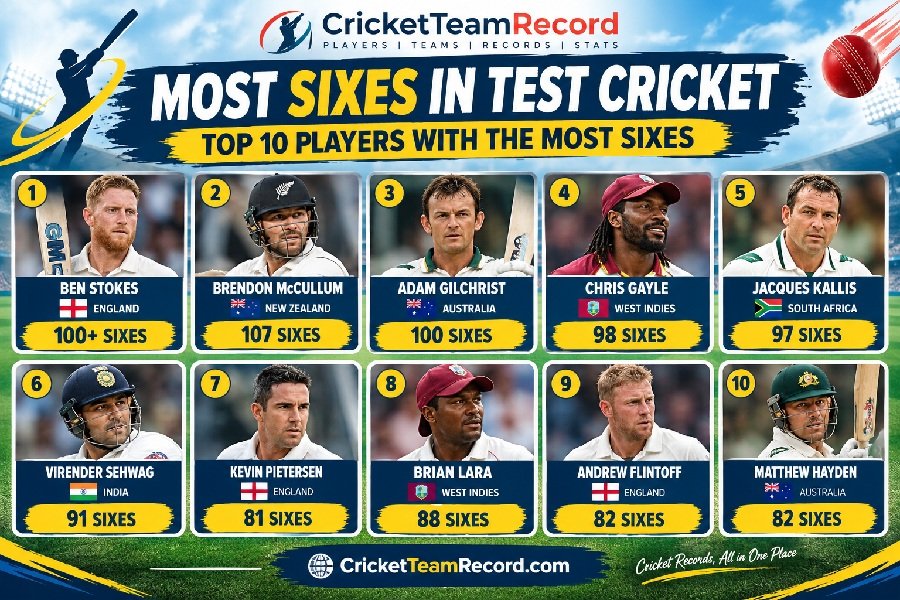
Here is an overview of some of the leading six-hitters in Test cricket history:
| Rank | Player | Country | Test Sixes |
| 1 | Ben Stokes | England | 100+ |
| 2 | Brendon McCullum | New Zealand | 107 |
| 3 | Adam Gilchrist | Australia | 100 |
| 4 | Chris Gayle | West Indies | 98 |
| 5 | Jacques Kallis | South Africa | 97 |
| 6 | Virender Sehwag | India | 91 |
| 7 | Kevin Pietersen | England | 81 |
| 8 | Brian Lara | West Indies | 88 |
| 9 | Andrew Flintoff | England | 82 |
| 10 | Matthew Hayden | Australia | 82 |
Statistics can change for active players. Verify the latest official figures before publication.
1. Ben Stokes – England
Ben Stokes is one of the most aggressive Test batsmen of the modern era. His ability to attack bowlers while playing long innings has made him a standout six-hitter in Test cricket.
Stokes has regularly used his power against both pace and spin. He is particularly dangerous when he decides to accelerate the scoring rate.
His aggressive batting style fits perfectly with modern attacking Test cricket. He has produced several innings where sixes have changed the momentum of a match.
For England, Stokes has also played important all-round roles, contributing with both bat and ball.
His six-hitting ability is one of the reasons he remains such an entertaining player to watch in Test cricket.
2. Brendon McCullum – New Zealand
Former New Zealand captain Brendon McCullum was one of the most aggressive batsmen of his generation.
McCullum finished his Test career with more than 100 sixes and became one of the few players to cross the 100-sixes mark in Test cricket.
He was famous for attacking from the beginning of an innings. Instead of waiting for loose deliveries, McCullum often put pressure on bowlers with aggressive strokes.
One of the highlights of his Test career was his triple century against India in 2014. His 302-run innings included numerous boundaries and demonstrated his ability to combine patience with explosive batting.
McCullum’s approach helped redefine aggressive batting in Test cricket.
3. Adam Gilchrist – Australia
Adam Gilchrist was one of the most destructive wicketkeeper-batsmen in cricket history.
The Australian left-hander changed expectations about what a wicketkeeper could contribute with the bat. He regularly attacked bowlers and scored quickly in Test matches.
Gilchrist finished his career with 100 Test sixes. His powerful hitting was particularly effective against fast bowlers and spinners.
He was also famous for producing match-changing innings under pressure.
Gilchrist’s combination of wicketkeeping skills, aggressive batting, and consistency made him one of Australia’s most valuable Test players.
4. Chris Gayle – West Indies
Chris Gayle is widely recognized for his enormous hitting power.
The West Indies opener was capable of hitting sixes against almost any type of bowling. Although he became particularly famous for his performances in T20 cricket, Gayle also produced several outstanding Test innings.
He finished his Test career with 98 sixes.
Gayle’s powerful straight drives, lofted shots, and pulls made him a constant threat whenever he was settled at the crease.
His Test career included multiple centuries and several dominant innings.
5. Jacques Kallis – South Africa
Jacques Kallis was one of the greatest all-rounders in Test cricket.
Although Kallis was known primarily for his consistency and technique, he was also capable of powerful hitting. He finished his Test career with 97 sixes.
Kallis played a huge number of Test matches and scored more than 13,000 Test runs.
His ability to combine a solid defensive game with powerful attacking shots made him an exceptional all-round batsman.
His six-hitting record is particularly impressive considering the traditional approach he often used during the early parts of his innings.
6. Virender Sehwag – India
Virender Sehwag was one of India’s most aggressive opening batsmen.
Sehwag often attacked from the first over and was comfortable taking risks against fast bowlers and spinners.
He finished his Test career with 91 sixes.
One of his most famous achievements was scoring two triple centuries in Test cricket. His attacking approach allowed him to score hundreds at a remarkable pace.
Sehwag’s fearless batting style made him one of the most entertaining Test batsmen of his generation.
7. Kevin Pietersen – England
Kevin Pietersen was known for his innovative and aggressive batting style.
The England batsman regularly used his feet against spin and was not afraid to play attacking shots in Test cricket.
He finished his career with more than 80 Test sixes.
Pietersen was particularly effective when he was able to dominate spin bowling. His range of shots allowed him to score runs in areas that many traditional Test batsmen did not target.
8. Brian Lara – West Indies
Brian Lara is regarded as one of the greatest batsmen in cricket history.
The West Indies legend was famous for his elegant stroke play and ability to produce enormous innings.
Lara finished his Test career with 88 sixes.
His most famous Test achievement was his world-record individual score of 400 not out against England in 2004.
Although Lara’s batting was often associated with timing and elegance, he was also capable of powerful hitting when required.
9. Andrew Flintoff – England
Andrew Flintoff was a powerful all-rounder who played an important role for England during his international career.
He was particularly dangerous when attacking fast bowlers and could change the course of a Test match within a short period.
Flintoff hit more than 80 sixes in Test cricket.
His aggressive batting, combined with his fast bowling and fielding ability, made him one of England’s most important all-rounders during his era.
10. Matthew Hayden – Australia
Matthew Hayden was one of Australia’s most powerful opening batsmen.
The left-hander was known for his physical strength and aggressive approach at the crease.
Hayden scored more than 8,000 Test runs and hit over 80 sixes during his career.
His ability to dominate bowling attacks, particularly when he was able to get his front foot moving, made him a dangerous opening batsman.
Why Are Sixes Less Common in Test Cricket?
Test cricket is fundamentally different from limited-overs cricket.
In T20 cricket, batsmen are often encouraged to attack from the first ball because there are only 20 overs available to score runs.
In Test cricket, batsmen can potentially spend hours at the crease. As a result, they often prioritize survival, technique, and building partnerships.
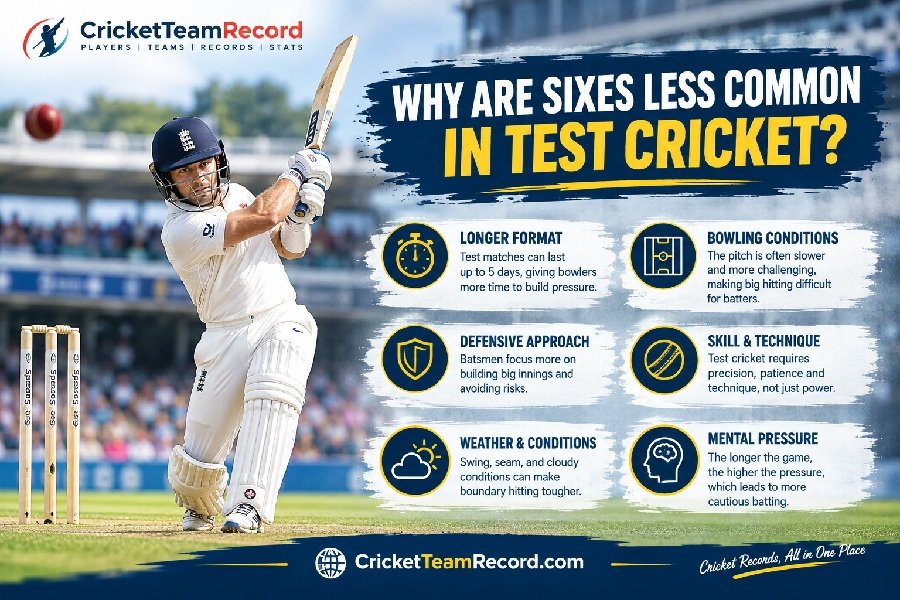
There are several reasons why sixes are less common in Tests:
1. Longer Innings
A Test batsman can spend several hours at the crease. There is usually no need to attack every delivery.
2. New Ball Movement
The new red ball can swing and seam significantly, making aggressive shots riskier.
3. Field Placements
Captains can use attacking field settings to put pressure on batsmen.
4. Match Situation
A batsman may choose defense when the team needs to save a Test match or build a large first-innings total.
5. Pitch Conditions
Some Test pitches are difficult for attacking batting, particularly when there is significant seam or spin.
Most Sixes in a Test Innings
While career six records are impressive, some batsmen have also produced extraordinary six-hitting performances in individual Test innings.
Aggressive batsmen can sometimes hit a large number of sixes when conditions are favourable.
Modern Test cricket has also seen an increase in attacking batting, particularly with teams adopting more aggressive approaches.
Most Sixes in Test Cricket by Indian Players
India has produced several aggressive batsmen who have hit large numbers of sixes in Test cricket.
Some notable Indian Test six-hitters include:
- Virender Sehwag
- Rohit Sharma
- MS Dhoni
- Sourav Ganguly
- Yuvraj Singh
- Ravindra Jadeja
Virender Sehwag is particularly famous for his aggressive approach and remains one of India’s most memorable Test six-hitters.
Rohit Sharma has also produced several powerful Test innings since becoming a regular Test opener.
Most Sixes in Test Cricket by an Innings
The number of sixes in an individual innings can depend heavily on pitch conditions, match situation, and a player’s batting approach.
Batsmen who are trying to accelerate the scoring rate often use lofted shots to clear the boundary.
Some of the biggest six-hitting innings in Test history have come during dominant performances when batsmen were able to attack tired bowlers.
Sixes in Test Cricket vs ODI and T20 Cricket
The frequency of sixes varies significantly between cricket formats.
| Format | Typical Batting Approach | Six-Hitting Frequency |
| Test Cricket | Patient and adaptable | Lower |
| ODI Cricket | Balanced aggression | Moderate |
| T20 Cricket | Highly aggressive | Higher |
Test cricket gives batsmen much more time, while T20 cricket puts greater emphasis on maximizing every delivery.
This makes a high number of Test sixes particularly impressive because players generally do not need to take the same risks as they do in shorter formats.
How Do Test Batsmen Hit More Sixes?
A successful Test six-hitter generally needs excellent timing and shot selection.
Power is important, but it is not the only factor.
Strong Batting Technique
A solid base allows a batsman to generate power without losing balance.
Good Hand-Eye Coordination
Six-hitting requires a batsman to make clean contact with the ball.
Reading the Bowler
Experienced batsmen can identify which deliveries are suitable for attacking shots.
Confidence
A batsman needs confidence to take calculated risks against international bowlers.
Match Awareness
The best players know when to attack and when to defend.
Frequently Asked Questions
Who has hit the most sixes in Test cricket?
The all-time Test sixes record is held by one of the format’s most aggressive batsmen. Because statistics can change for active players, the latest official records should be checked before publication.
Who is the most aggressive Test batsman?
Several players have earned reputations for aggressive Test batting, including Brendon McCullum, Virender Sehwag, Adam Gilchrist and Ben Stokes.
Who has hit the most sixes for India in Test cricket?
Virender Sehwag is among India’s leading Test six-hitters. Rohit Sharma and other modern Indian batsmen have also produced significant six-hitting records.
Why are sixes rare in Test cricket?
Test cricket rewards patience and long innings, so batsmen generally do not need to attack every delivery. Pitch conditions, field settings, match situations, and the new ball can also make six-hitting more difficult.
Are Test sixes more difficult than T20 sixes?
The difficulty depends on the delivery and conditions, but Test batsmen often face different tactical situations. A batsman may have to attack an experienced bowler while also managing the risks associated with a long innings.
Conclusion
The most sixes in Test cricket is an interesting record because Test cricket traditionally emphasizes patience, technique, and endurance rather than constant attacking.
Players such as Brendon McCullum, Adam Gilchrist, Chris Gayle, Jacques Kallis, Virender Sehwag, Brian Lara and Ben Stokes have shown that Test batsmen can combine traditional skills with explosive power.
Their six-hitting records have added another exciting dimension to the longest format of the game.
As modern Test cricket continues to evolve, aggressive batting and faster scoring rates are becoming increasingly important. Future generations of batsmen may challenge existing six-hitting records and push the boundaries of what is possible in Test cricket.